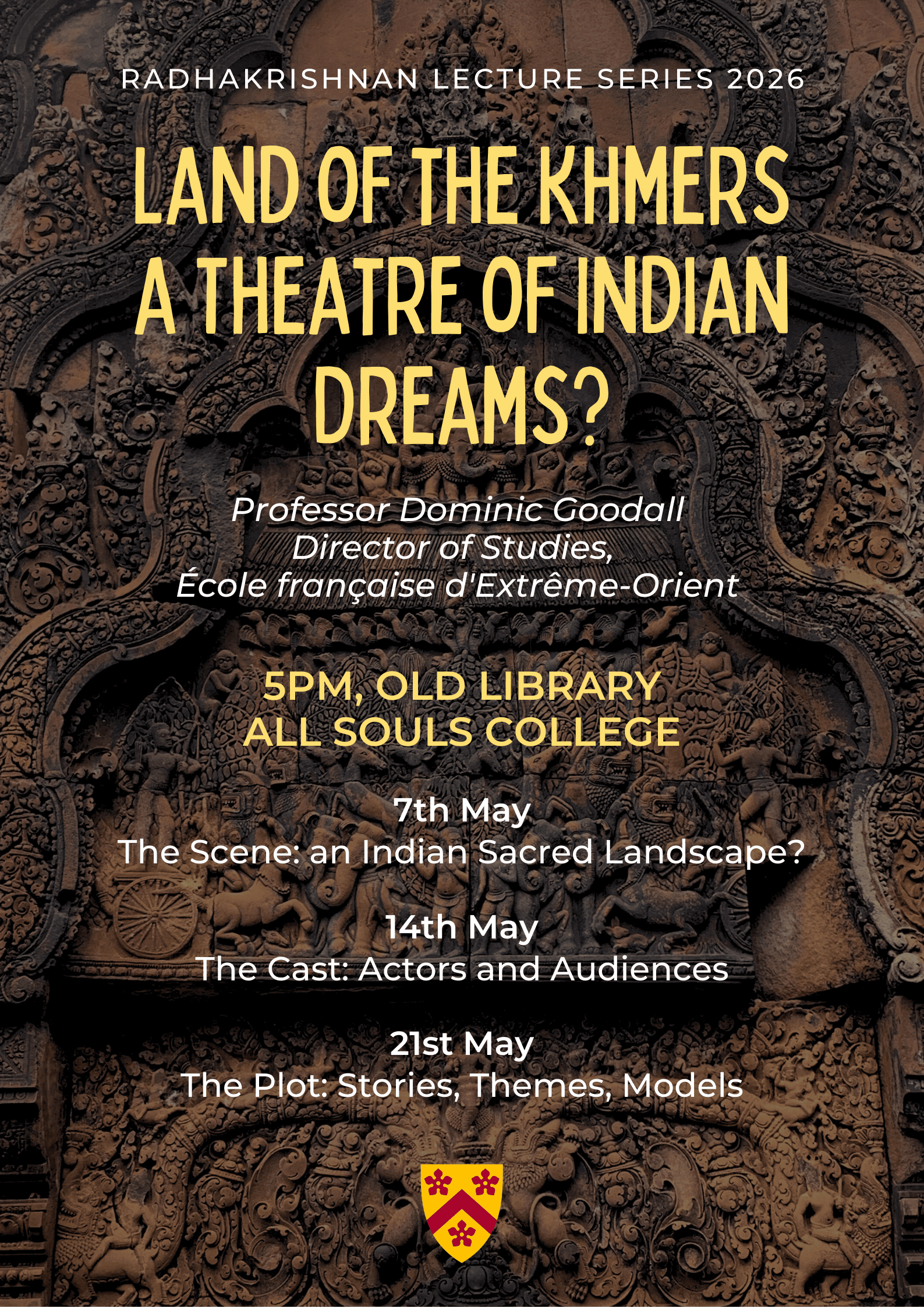
Radhakrishnan Lectures 2026: Lecture 1. The Scene: an Indian Sacred Landscape?
Radhakrishnan Lectures 2026: The Land of the Khmers, a Theatre of Indian Dreams?
The Land of the Khmers, a Theatre of Indian Dreams?
The Scene: an Indian Sacred Landscape? Thursday 7th May (Trinity wk 2)
The Cast: Actors and Audiences Thursday 14th May (Trinity wk 3)
The Plot: Stories, Themes, Models Thursday 21st May (Trinity wk 4)
Dominic Goodall (EFEO, Pondicherry)
“Victorious is He whose diadem is the moon, who bears upon his head the Gaṅgā, like a perfect creeper formed of a garland of waves as crooked as Umā’s frown!”
Carved into the doorjamb of the entrance to a shrine that commands an awe-inspiring view of a huge swathe of the Mekong river is a 47-verse Sanskrit inscription (K. 81) that begins with this eulogy of Śiva receiving the Gaṅgā in his matted locks, thus breaking the force of the celestial river as she fell to earth.
These illustrated lectures will show how the Khmer-speaking region is figured as a North Indian sacred landscape traversed by the Ganges, inhabited by the descendants of a Rishi (the sage Kambu) and governed by royalty who embody the gods of the directions, who intermarried with brahmins, who professed Indian religions and Indian ideals of behaviour and who fostered the study of Sanskrit literature.
Veritable archives in stone, the roughly 1600 inscriptions of ancient Cambodia (5th-14th centuries CE) written in Sanskrit and Old Khmer will be our main source. Indeed they are the only surviving locally produced written documents of that period.
Almost always in verse, the Sanskrit portions are often remarkable for their grandiloquent classicism. Panegyrics to gods, rulers, and notables, they testify to a high degree of assimilation of Sanskritic culture: science (especially grammar and astronomy), philosophy, mythology, belles lettres, and rhetoric.
Who were the authors of this political poetry densely packed with conscious echoes of the Mahābhārata and Rāmāyaṇa and of the works of Kālidāsa, Bāṇa, Bhāravi, Mayūrabhaṭṭa, and Māgha, and who were its intended audience? And what does their poetry tell us about what they really thought about themselves?