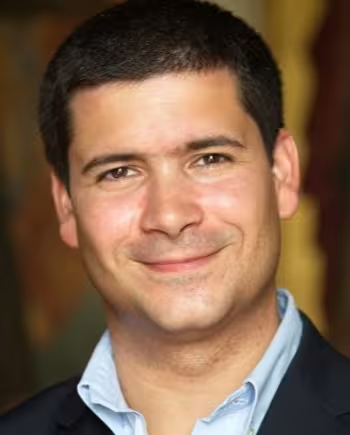
Dr Nuno Castel-Branco

Dr Nuno Castel-Branco

PhD, MSc
History
Post-Doctoral Research Fellow since 2023

Nuno Castel-Branco is a Research Fellow at All Souls College, Oxford. He completed his Ph.D. in the history of science at Johns Hopkins University in 2021 after earning a Bachelor’s and Master’s in Physics at the University of Lisbon. Previously, he worked as a Research Fellow at Harvard University’s Villa I Tatti in Florence and at the Max Planck Institute for the History of Science in Berlin. His first book, The Traveling Anatomist: Nicolaus Steno and the Intersection of Disciplines in Early Modern Science was published by the University of Chicago Press in October 2025. His research has been generously supported by institutions such as the Fulbright Program, the Andrew Mellon Foundation, the Royal Society, and, more recently, the John Fell Fund from the University of Oxford. His writing has also appeared in publications such as Isis, Renaissance Quarterly, and Annals of Science, as well as in The Wall Street Journal, The Washington Post, and Scientific American.

Research Areas
History of Science
History of Physics, Mathematics, and the Life Sciences
History of Ideas
History of Religion
Early Modern Europe and Its Oceanic Expansion
Science and Religion

Selected Publications

The Traveling Anatomist: Nicolaus Steno and the Intersection of Disciplines in Early Modern Science

(University of Chicago Press, 2025)

"Thinking the Earth with the Body: How the Anatomist Nicolaus Steno (1638–1686) Read History in the Earth’s Strata."

Isis 115 (2024)

"Physico-Mathematics and the Life Sciences: Experiencing the Mechanism of Venous Return, 1650s-1680s”

Annals of Science 79 (2022)

“Drawing Muscles with Diagrams: How Novel Dissection Cuts Inspired Nicolaus Steno’s Myology (1667).”

Notes and Records of the Royal Society (2022). (co-authored with Troels Kardel, MD).

“Material Piety: Science and Religious Culture in Seventeenth-Century Portugal”

Renaissance Quarterly 74 (2021)

Winner of Oliveira Marques Prize for Best Article in the History of Portugal

Current Projects: Expanding Expertise

A unifying theme that runs across my research is the role of friendships in the history of knowledge. My second project explores how mathematicians, anatomists, and patrons cooperated in the early 1600s. I am placing Renaissance studies of animal motion at the center of this research, and it includes the work of Galileo Galilei and William Harvey. A poorly known actor is Hendrick Uwens, a Jesuit missionary who taught animal motion in a mathematics course in Lisbon in the early 1640s before sailing to the Islamic Mughal empire in northern India. This project builds upon my previous research on early modern Italy and the Iberian world.