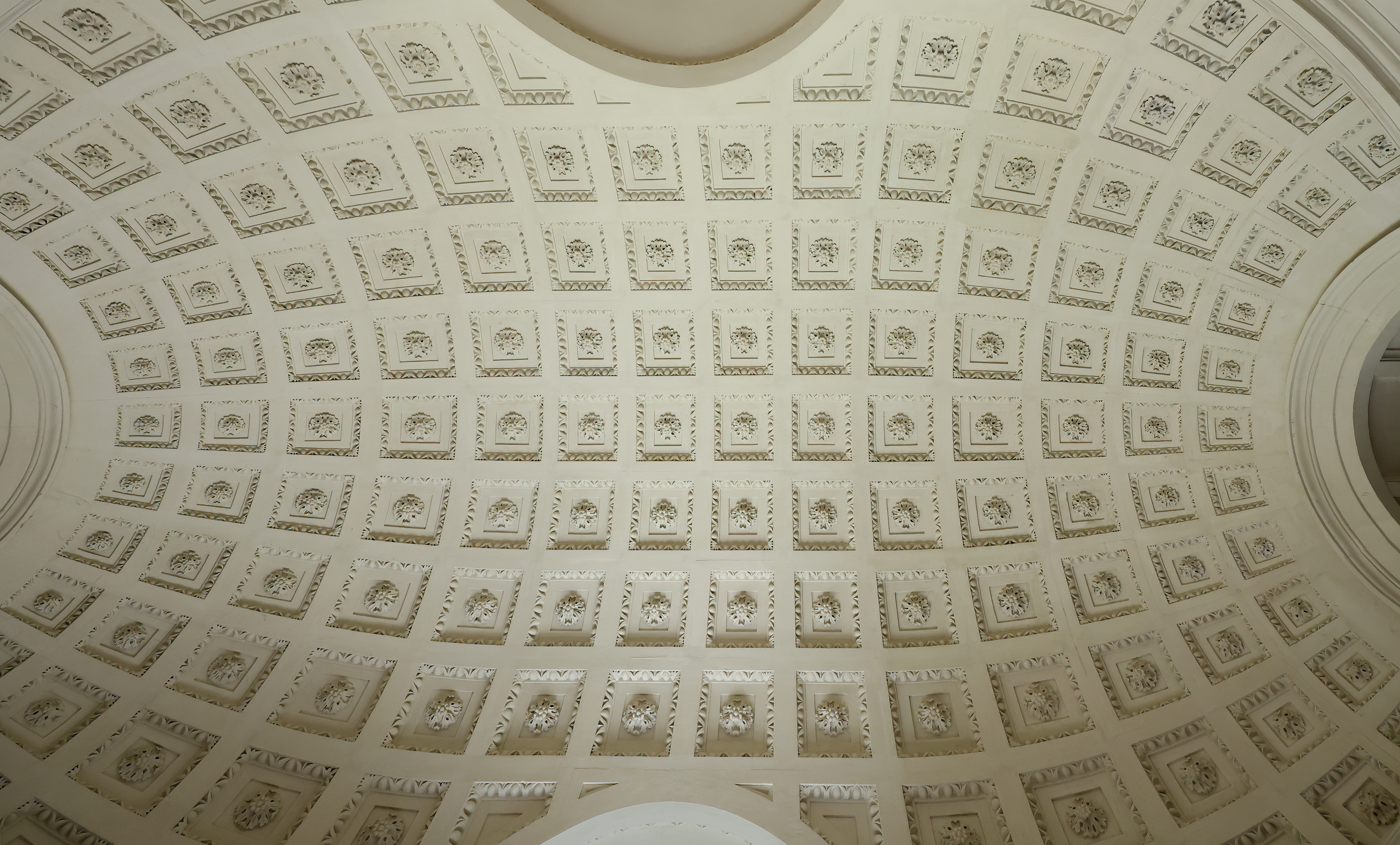
A single mathematical principle unifies the Roman Pantheon, Mercator's Projection and Hawksmoor's Ceiling
The Pantheon in Rome is generally considered to be one of the greatest joint achievements of the arts and science in human history. Other contenders for this title might include Mercator's map projection of the Earth’s curved surface onto a flat chart, and, less well known but equally deserving, Nicholas Hawksmoor's exquisitely coffered ceiling in All Souls College, Oxford. Although these examples differ widely, a recent paper in Proceedings of the Royal Society by John Cardy, a theoretical physicist and Emeritus Fellow of All Souls, suggests that their geometrical forms are based on a single mathematical principle, that of conformal symmetry. This gives quantitative predictions which agree well with photographs and direct measurement.
The Pantheon is one of the most celebrated surviving Roman antiquities. The version that we see today was constructed around 125 CE under the rule of Hadrian. Its most remarkable feature is a domed ceiling, a hemisphere 43 metres in diameter, composed almost entirely of concrete of varying thickness and composition. Its interior is coffered, an architectural design feature that uses a grid of sunken panels to reduce the stress on the structure without sacrificing its strength. It also has aesthetic appeal, as the recessed coffers create repeated shadows suggesting depth. Individual coffers may be of any shape, but in the examples considered they are all (approximately) square.
The Pantheon coffering was extensively copied, but it was not until the 18th century that coffering became a popular decorative style. An exquisite but little known example is the ceiling of the Buttery in All Souls College, Oxford, a small room in which drinks were stored in ‘butts’. It was designed around 1733 by the English architect Nicholas Hawksmoor. Unlike the Pantheon’s dome, this ceiling has a horizontal rather than a vertical axis of symmetry. In both cases the double curvature of the ceiling means that they cannot be coffered, even approximately, with squares all of the same size. The resolution adopted by the Romans and by Hawksmoor was to allow the coffer sizes and orientations to vary according to their location, while maintaining their square shape as far as possible. However, the principle by which their overall geometry is then fixed has, up to now, been a subject for speculation.
Cardy suggests that the missing element is conformality. Any coffering of the ceiling may be regarded as the image of a regular square coffering of a flat surface under a smooth mapping between the two. This allows the use of calculus, or rather its 19th century version, differential geometry. The requirements that each coffer be almost square, with their edges meeting at 90°, are satisfied if the mapping is conformal: it preserves the relative angle between any two intersecting curves. Such a mapping always exists for any shaped ceiling, although if the number of coffers is to be finite there is a discrete set of allowable mappings, which includes the Hawksmoor ceiling and the Pantheon dome. Moreover the detailed predictions of conformality are shown to agree well with photographic evidence, and direct measurements where available. He also argues that conformality is a consequence of a balance between the forces of gravity and the elastic stresses in the structure.
The coffering of the Pantheon ceiling had to be close to conformal, or it would have fallen down by now.
Against the obvious objection that neither the Romans nor Hawksmoor knew anything of 19th century mathematics, he points out that there are simpler ad hoc protocols which could have been followed by the original architects, and which, if stable, should yield the same results as the conformal hypothesis.
As a bonus, conformality implies a previously unnoticed connection with another famous problem: that of representing Earth’s doubly curved surface on a flat navigational chart from which the compass bearing for a given destination may be read off directly. This was solved in 1569 by Mercator’s famous projection. Since this preserves angles, it is also conformal, and is in fact the mathematical inverse of the Hawksmoor mapping. Did Hawksmoor know enough of Mercator’s mathematical argument to apply it to his own problem? Probably not, but it's a fascinating possibility.
The author, Professor John Cardy FRS, was a Senior Research Fellow (now Emeritus) of All Souls College, and a Professor in the Department of Physics, at the University of Oxford from 1993 to 2014. His work on applications of conformal symmetry in theoretical physics has been recognized with several major international awards, including the Dirac Medal, the Boltzmann Medal, and the Breakthrough Prize in Fundamental Physics. He now resides in California.